
An explosion that changed the atmosphere for years
New research from Aarhus University reveals an unexpected interaction between water vapour and sulphur particles following the powerful Hunga volcanic eruption in 2022. The findings shed new light on how volcanic eruptions affect the atmosphere and climate.

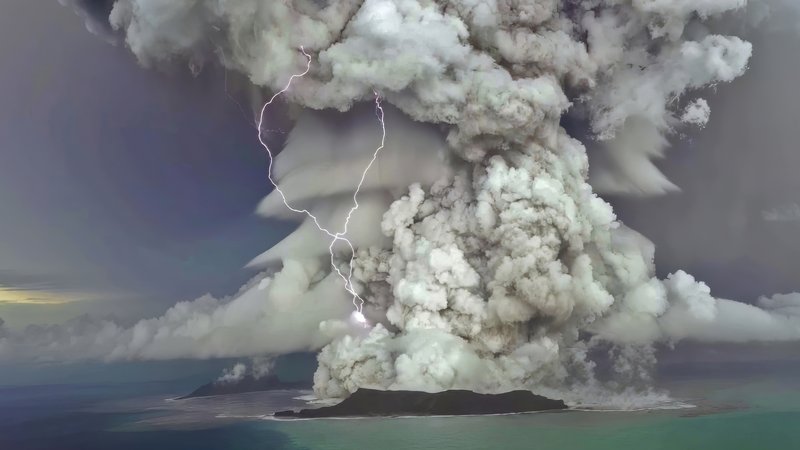
When the Hunga volcano erupted in the Pacific Ocean in January 2022, it blasted enormous amounts of water vapour and sulphur compounds high into the atmosphere. Ever since, scientists have been trying to understand why the eruption had such unusual and long-lasting effects on atmospheric chemistry and temperature.
Now, an international research team led by Associate Professor Freja Chabert Østerstrøm from the Department of Environmental Science at Aarhus University has uncovered an important part of the explanation.
The researchers found that the water vapour and tiny sulphur particles influenced each other far more than expected. The water vapour accelerated the growth of the particles. But the particles also changed how the water vapour travelled through the atmosphere.
"I expected the water vapour to affect particle formation and chemical reactions. What surprised me was just how much the particles influenced the movement of water vapour – and that the water vapour, in turn, also affected how the particles moved," she says.
The discovery shows why scientists need to consider water vapour and sulphur together to understand how volcanic eruptions affect the atmosphere.
Separating water from sulphur
To investigate what happened after the eruption, the researchers used a computer model that simulates chemical reactions and the movement of air high in the atmosphere.
They ran three different simulations.
First, they examined what would have happened if the volcano had released only water vapour. Next, they simulated the effects of sulphur dioxide alone. Finally, they included both substances, as occurred during the actual eruption.
The third simulation told a different story than simply adding the other two together.
When sulphur dioxide reaches the upper atmosphere, it gradually transforms into tiny particles containing sulphuric acid, known as sulphate aerosols.
Scientists already knew that water vapour can affect how quickly these particles form and how large they grow.
But the new simulations revealed that the influence works both ways.
When the researchers left sulphur dioxide out of the model, the water vapour moved more quickly through the stratosphere but did not reach the same heights. The stratosphere is the layer of the atmosphere above the region where our weather takes place.
When both water vapour and sulphur dioxide were included, they affected the surrounding temperature and air currents differently than either substance did on its own. These changes helped carry both the water vapour and the particles higher into the atmosphere.
"Our results show that you need to include both water vapour and sulphur dioxide in the calculations if you want to understand the chemical changes and air movements following an eruption like Hunga," says Freja Chabert Østerstrøm.
Tiny particles also changed ozone chemistry
The interaction between water vapour and sulphur also affected the ozone layer, which protects life on Earth from some of the Sun's harmful ultraviolet radiation.
Sulphate particles provide tiny surfaces where chemical substances can meet and react.
Some of these reactions accelerate the breakdown of ozone. Others slow it down.
Which effect dominates depends partly on how high in the atmosphere the reactions take place.
The researchers found that water vapour altered particle size, temperature and chemical reactions. As a result, the model that included both water vapour and sulphur dioxide produced different patterns of ozone change from the simulations that included only one of the two substances.
The findings help explain why an eruption that releases unusually large amounts of water vapour can affect the ozone layer differently from a more typical volcanic eruption.
New insights could improve climate models
The findings matter because scientists rely on computer models to investigate how major volcanic eruptions may affect Earth's climate.
When volcanoes release sulphur compounds into the atmosphere, the particles that form can reflect some of the Sun's light back into space. This can help cool Earth's surface.
Water vapour, on the other hand, is a greenhouse gas. Understanding what happens when an eruption releases large amounts of both substances is therefore important.
According to Freja Chabert Østerstrøm, the research raises new questions.
How little water vapour does it take to change the way sulphate particles develop? And how much water vapour would an eruption need to release for its overall effect on Earth's surface temperature to shift from cooling to warming?
"We now have a more nuanced understanding of why the composition of a volcanic eruption matters. It also makes it interesting to revisit eruptions from the past," she says.
She points out that some climate models do not yet account for the way water vapour and sulphur particles interact following a volcanic eruption.
And Hunga has demonstrated just how much there is still to learn.
"Even though scientists have studied Earth's atmosphere and stratosphere for many years, we still encounter entirely new conditions that we need to investigate. When Hunga erupted, we didn't know what to expect," says Freja Chabert Østerstrøm.
The researchers now have a clearer picture of what happens when water vapour and sulphur interact high above Earth. That knowledge could help scientists better understand the consequences of future volcanic eruptions.
Contact
Associate Professor Freja Chabert Østerstrøm
Department of Environmental Science, Aarhus University
Mail: freja@envs.au.dk
Tel.: +4587150623