Aarhus University Seal

Pursue a Work-integrated Master’s degree programme

Start your engineering career while studying for your Master of Science in Engineering degree

Universities in Denmark are currently implementing a national reform of Master's degree programmes. This means that, as a student, you can pursue a Master of Science in Engineering degree through a new Work-integrated Master’s programme scheme.


As a student enrolled in a Work-integrated Master’s programme, you combine your studies with a part-time job in a company, allowing you to begin your career as an engineer while continuing your education.

You may already be a Bachelor of Engineering or a Bachelor of Science in Engineering and and well into your professional journey. The Work-integrated Master’s programme enables you to pursue a Master of Science in Engineering degree while keeping your job and earning a salary.

AU Engineering will offer all Master’s programmes (cand.polyt.) as Work-integrated Master’s programme track.

Benefits of choosing a Work-integrated Master’s degree programme

As a student enrolled in a Work-integrated Master’s degree programme, you will gain:

  • A salary instead of SU during all or most of your studies
  • Valuable experience and a professional network in the industry
  • A Master’s degree with the same academic level and title as the regular programme
  • A daily routine that alternates between university and company work
  • The opportunity to link your study projects directly to your job

Two ways to pursue a Work-integrated Master’s degree programme

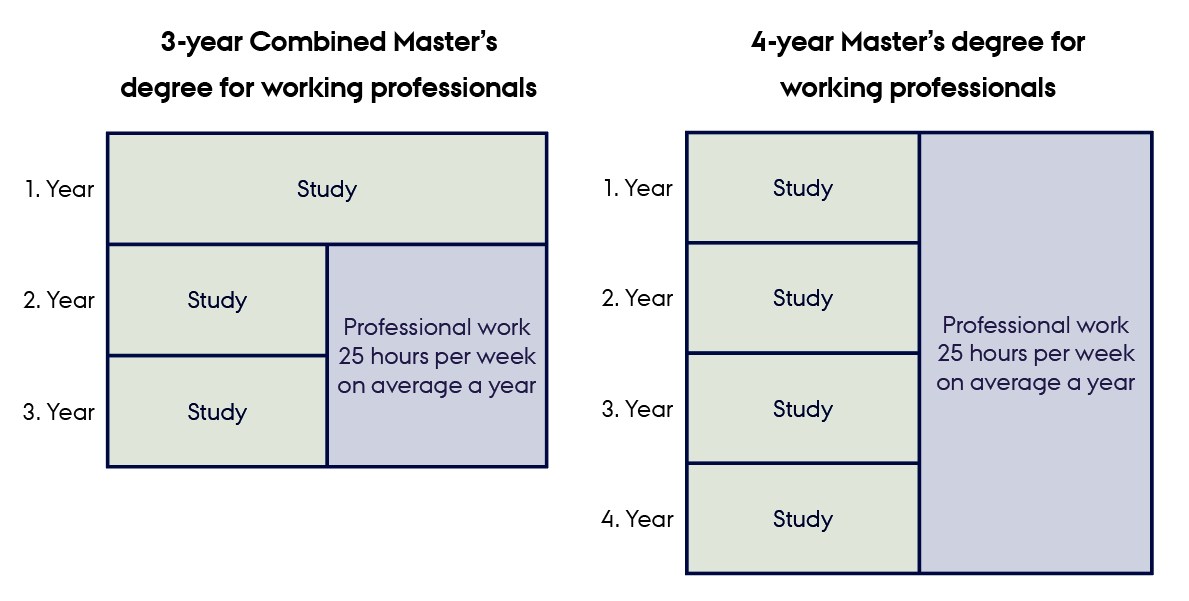
As an engineering student, you can choose between two study tracks within the professional Master’s programme: "Flexible work-integrated Master’s degree programme" and "1+2 work-integrated Master’s degree programme".

Below, you can read more about the two tracks. Regardless of which path you choose, you will graduate as a Master of Science in Engineering (cand.polyt.).


1+2 work-integrated Master’s degree programme: One year of full-time study + two years of part-time employment with with ongoing university courses

  • This model is a special opportunity offered to engineering students in Denmark. You begin with one year of full-time study, following the standard Master’s programme. After that, you combine two years of part-time study with relevant employment, averaging 25 hours per week annually.
  • The programme comprises 120 ECTS credits.
  • You receive SU during the first year and a salary from your employer during the following two years. The salary is agreed upon between you and the company, but should be based on the standard salary level for newly qualified Bachelor of Engineering graduates.
  • You may also meet the employment requirement by working as a self-employed professional.

Flexible work-integrated Master’s degree programme: Four years combining study and work

  • This pathway allows you to alternate between study and employment throughout the entire four-year programme. You complete the degree as a part-time student while working in a relevant position, averaging 25 hours per week annually.
  • The programme comprises 120 ECTS credits.
  • You are not entitled to SU but you receive a salary from your employer throughout the programme.
  • You may also meet the employment requirement by working as a self-employed professional.

What are the employment requirements?

You must be employed in a company where your tasks align with your academic programme, and where you have flexibility during exam periods and teaching activities. Aarhus University must approve the academic relevance of your job as part of your application for admission to the Work-integrated Master’s degree programme. This ensures that you gain meaningful learning outcomes throughout your studies.

How can I find a relevant company for employment?

It is your own responsibility to find a company that is willing to employ you as a student enrolled in a Work-integrated Master’s degree programme. However, you are likely to be in high demand. Work-integrated Master’s students are considered an attractive recruitment channel for businesses, especially in a labour market facing a shortage of engineers.

Companies looking to hire students enrolled in a Work-integrated Master’s degree programme often post job openings on job portals and LinkedIn. You can also meet them at career fairs, company visits, and networking events at the university.


Get help finding the right match

You are always welcome to contact us before applying. We are happy to guide you towards a company or position that aligns with your interests.


What to expect:

  • Support in finding a company that matches your professional interests and goals
  • Insights into what employers value
  • Review of your job’s academic relevance to ensure optimal learning outcomes

A strong match between student and company is key to a rewarding Work-integrated Master’s programme for both parties. Below, you can read more about how we help facilitate the right collaboration and ensure a successful experience.

Get support in finding the right match

What can I expect financially?

As a Work-integrated Master’s programme student, you enter the job market while studying for your Master of Science in Engineering and you will notice the difference in your finances.

  • As a 1+2 work-integrated Master’s degree programme student, you receive SU during the first year and a salary from your employer during the final two years.
  • As a Flexible work-integrated Master’s degree programme student, you receive a salary throughout the entire programme.
  • The salary is agreed upon between you and the company – many use the recommended starting salary for newly graduated Bachelor of Engineering students as a reference point. 

What does an engineer earn?

As a Work-integrated Master’s student, the university requires that your employment, whether in a company or as self-employed, is academically relevant. This means that, based on your Bachelor of Science in Engineering degree or your Bachelor of Engineering degree, your salary should reflect the recommended minimum salary levels.

Which Work-integrated Master’s degree programmes are offered at Tech?

From February 2026, the following will be offered both as the regular two-year Master's degree program and as a four-year flexible work-integrated Master’s degree programme:


From summer 2026, the following is expected to be offered both as the regular two-year master's degree program and as a 1+2 work-integrated Master’s degree programme.

How do I apply for a Work-integrated Master’s degree programme?

If you want to apply for a Work-integrated Master’s degree programme, you must follow the same admission procedure as for a regular Master’s programme – but with a few additional steps.

  1. Find a company
    You must find a workplace with relevant tasks (at least 25 hours per week on average). Use your network, career fairs, and AU Engineering’s Matchmaking Service.
  2. Enter into an agreement
    Your employment contract must meet certain requirements – we will help you make sure everything is in order.
  3. Apply for admission
    Apply through the regular Master’s application system – remember to select “Work-integrated Master’s degree programme”.

Read more about application and admission here (in danish)