
Researchers mimic the skin’s sense of touch in an artificial sensor
Researchers at Aarhus University have developed a tiny sensor that responds to touch in a similar way to our sensory cells. They hope the technology can pave the way for prostheses that can be connected directly to the nervous system and communicate with the brain.

You pick up a fragile glass from the table. Without thinking about it, you feel its surface against your fingertips and continuously adjust your grip. You hold it firmly enough to keep it from slipping out of your hand, but not so tightly that it breaks.
For you, this is a simple manoeuvre. But beneath the skin, you set off a sophisticated interplay of processes. The pressure from your fingertips opens tiny gates in the skin’s sensory cells, allowing electrically charged atoms to flow in. This shifts the electrical balance and triggers a nerve signal that travels towards the brain. There, the signal becomes part of the information that allows you to feel the touch and continuously adjust your grip.
Clever.
For Rassoul Tabassian, Assistant Professor at the Department of Mechanical and Production Engineering at Aarhus University, the body’s ability to convert touch into electrical signals that the nervous system can turn into information is more than clever. It is also a source of inspiration:
“A simple touch is actually an extremely sophisticated mechanical process. There is a great deal we can learn from it in engineering, and we want to become better at mimicking it in the laboratory,” he says.
He came to Aarhus University five years ago with a dream of developing skin for robots. Together with his research group, he has now achieved his first major scientific breakthrough with a sensor capable of mimicking the neural response mechanism.
The sensor is made from a soft, silicone-like material and is about the size of a small lentil. It can convert touch into an electric potential, which the researchers eventually hope can directly stimulate the nerves for being transmitted to the brain.
The results have been published in the scientific journal Advanced Functional Materials
An artificial sensory cell on the table
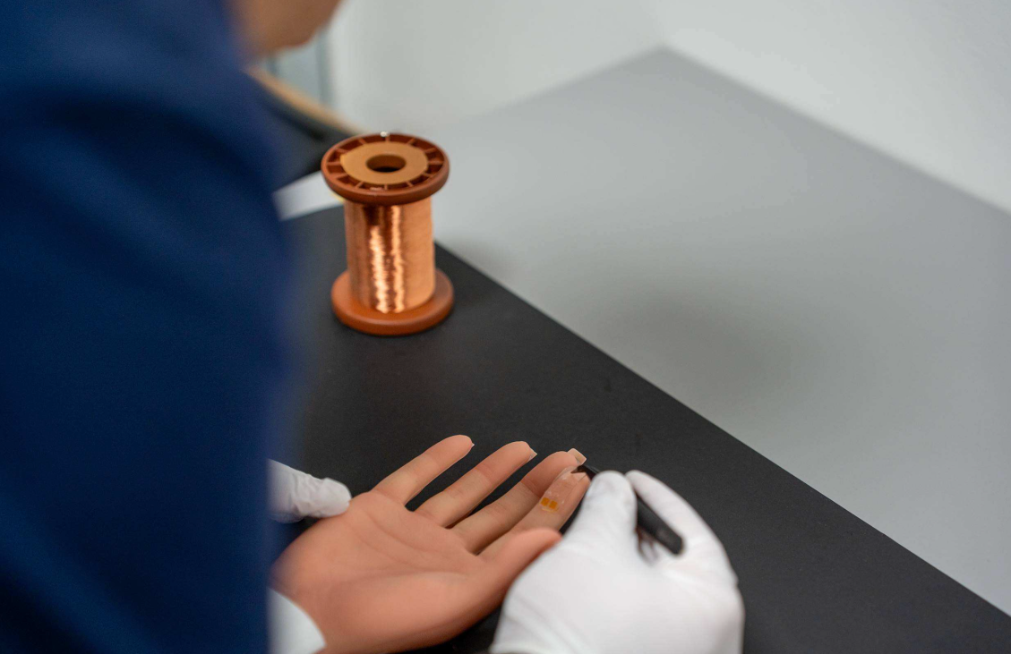
On the table in front of Rassoul Tabassian lies a soft prosthetic hand. Attached to the tip of one of its fingers is the researchers’ new sensor. It can detect when someone touches it.
That in itself, is nothing new.
Sensors already exist that can detect both touch and pressure and provide prostheses with information about their surroundings. But the person wearing the prosthesis is unable to feel that information.
“What is groundbreaking about our sensor is not the generation of a sensing signal; it is how the signal is generated. The signal generation mechanism of existing touch sensors is far different from what is happening in our body. And perhaps that’s why they are not able provide a real sensation for human body. Our new sensor can generate a signal by moving charged atoms similar to the way signals are generated in body’s sensory cells. Therefore, in the long term, this could make it possible to connect the sensor directly to the nervous system and give prostheses an artificial sense of touch. That is what we are working towards,” says Rassoul Tabassian.
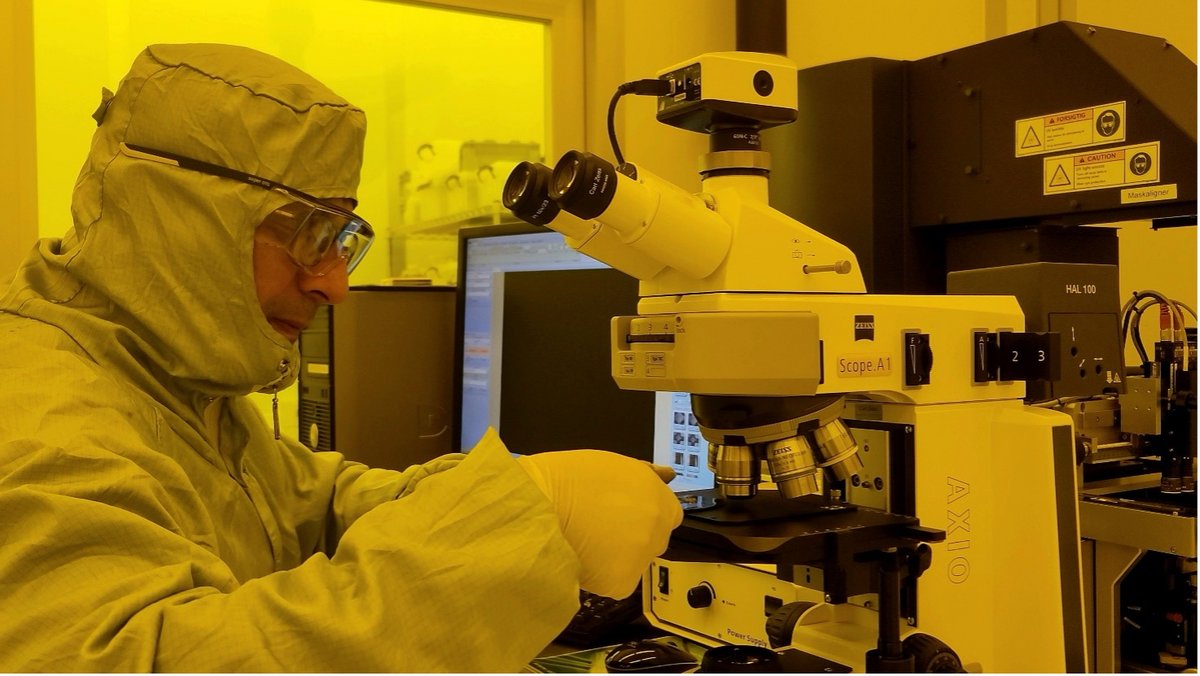
The researchers fabricated the sensor in the university’s cleanroom. It contains tiny chambers connected by a microscopic channel. Inside is salt water.
The salt water contains tiny electrically charged particles that move with the fluid. This shifts the electrical balance and generates a weak signal. The principle resembles what happens in the skin when sensory cells convert touch into information that the nervous system can transmit towards the brain.
“We cannot copy a sensory cell one-to-one. It is far too complex. But we can break it down into some of its fundamental principles and try to mimic them – and that is what we have succeeded in doing,” says Rassoul Tabassian.
Prostheses with a sense of touch could be the next step
Today, the first prototype of the sensor can detect a light touch, and it can pick up a pulse from a blood vessel in the wrist.
When the researchers place the sensor in a soft prosthetic hand, it can detect when it is touched. The sensor produces a signal that the researchers can readily measure using their laboratory equipment.
According to Rassoul Tabassian, the results are important and crucial for continuing the development of technology for prostheses with a sense of touch.
But the voltage generated by the sensor needs to exceed a threshold of around 20 millivolts to trigger a signal in a nerve cell.
He stresses that several more years of research will be required to move from a prototype artificial sensory cell to a prosthesis that can feel and move naturally, as though it were part of the human body.
“Our results have generated considerable interest and now give us a reason to take the research further. The next step is to make the sensor’s signal strong enough to stimulate the nervous system directly. That will require extensive experimental work in the laboratory, followed by a series of experiments, first in animals and later in humans,” he says.