
Teacher of the Year wants her students to stay curious
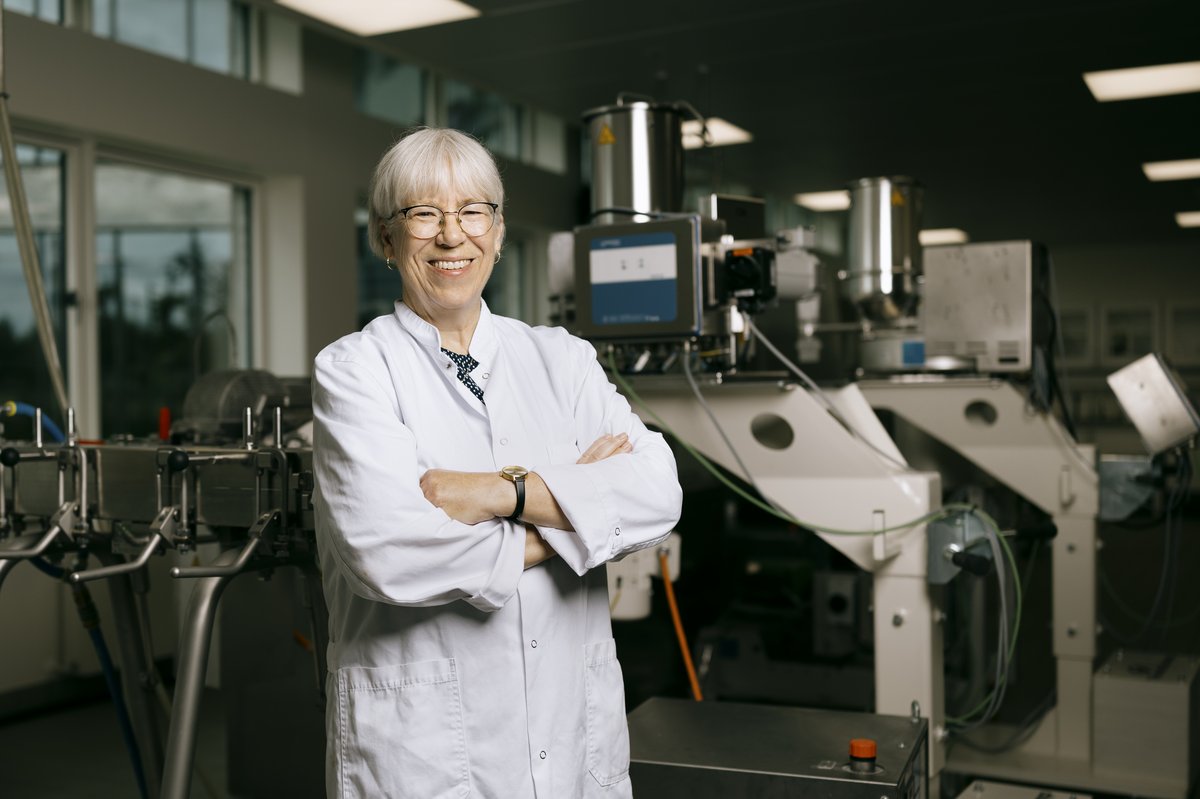
Ulla Kidmose wants her students to ask questions and challenge assumptions. That is why she creates a learning environment where they feel confident enough to speak up about what they find difficult and challenge the truths we take for granted. She is now receiving the Vibeke Borchsenius Prize as Lecturer of the Year at Aarhus University.

“Correct answers are often boring,” says Ulla Kidmose, associate professor at the Department of Food Science at Aarhus University.
Of course, she is exaggerating to make a point.
After all, as a scientist, she has spent a long career doing precisely that: finding answers.
What happens to taste when we reduce the amount of sugar and fat in our food? Can plant protein be turned into a tasty alternative to meat? And how can we develop a more sustainable food culture at a time when our food system needs to adapt to climate change?
But in her teaching, she is just as interested in what comes before the answer.
The question.
“Critical thinking and the ability to ask questions are some of the most important academic skills I can equip my students with for their future careers. That’s why much of my teaching is based on the principle that it should be engaging and inclusive. I want to spark their curiosity and prepare students to find their own way when they encounter problems or dilemmas for which they do not yet know the solution,” says Ulla Kidmose.
Curiosity as a driving force
Ulla Kidmose teaches students across Aarhus University.
On the Aarhus campus, she teaches BEng students in Food Technology; at her own department at Agro Food Park north of Aarhus, she teaches Master’s students in Molecular Nutrition and Food Technology; and at the Sino-Danish Center (SDC) in Beijing, she teaches both Danish and Chinese students in sensory science.
In other words, the students come from widely differing academic backgrounds and have different interests and ideas about where their education will take them. This places considerable demands on teaching, which must both embrace this diversity and give each individual the space to find their own path.
Yet there is a common thread running through Ulla Kidmose’s work as an associate professor. Good teaching creates room for curiosity and questioning, she believes:
“No question is too big, too small or too unconventional to be asked,” she says. She pauses for a moment and adds:
“Sometimes, the obvious questions are the best ones.”
A seemingly trivial question with an obvious answer may reveal assumptions that everyone else has taken for granted. It can take an academic discussion in a new direction. And every now and then, it can even make a seasoned researcher stop and think: I actually don’t know.
“I love it when I can get an entire class engaged in a discussion. It’s very inspiring, and I get a lot of input from my students when I develop new hypotheses. There have been several occasions when the questions sparked by their academic curiosity have inspired me to take new paths in my research,” she continues.
She knows she makes it sound easy.
In practice, however, creating the kind of inclusive learning environment where students feel confident enough to speak up, ask questions and challenge established ideas takes both time and effort.
“As a lecturer, you have to be willing to relinquish some control, and you have to invest in making your interactions with students safe, informal and personal,” she says.
The art of letting go
When supervising projects, Ulla Kidmose begins by guiding her students closely.
What is the problem? How can you investigate it? What knowledge are you missing? What is your next step?
But the goal is always for the students to develop their skills and take ownership of the project, so that her own role gradually becomes less prominent.
“You see them grow with the task. They become more confident, take greater responsibility and find their own way,” she says.
Gradually, the roles begin to shift.
The student no longer comes to her to be told what the next step should be. Instead, the student arrives with an argument. A decision. Perhaps even an academic disagreement.
For Ulla Kidmose, that is precisely when she knows the supervision has worked.
“This is what you hope for. That they reach a point where they take responsibility for their own choices, and where the relationship can become more equal and collegial,” she says.
Relationships that extend beyond the classroom
Perhaps this is also part of the reason why Ulla Kidmose remains in contact with many of her former students long after they have graduated.
“I’m interested in how my students are doing on a personal level and where they find jobs. As a researcher, this also helps me keep up to date with developments in a sector that is changing very rapidly,” she says.
Every year, in connection with Aarhus University’s annual celebration in September, the Aarhus University Research Foundation presents a prize for excellent and groundbreaking teaching.
The prize is named after Vibeke Borchsenius, who was known for her strong commitment to her students. The recipient receives DKK 75,000.
About the Vibeke Borchsenius Prize
The prize is named after the mathematician Vibeke Borchsenius, who worked at Aarhus University from 1957 to 1991.
Today, the prize is awarded to a lecturer who has made an outstanding and pioneering contribution to teaching at Aarhus University.
The prize is presented once a year in connection with the University’s Annual Celebration in September.