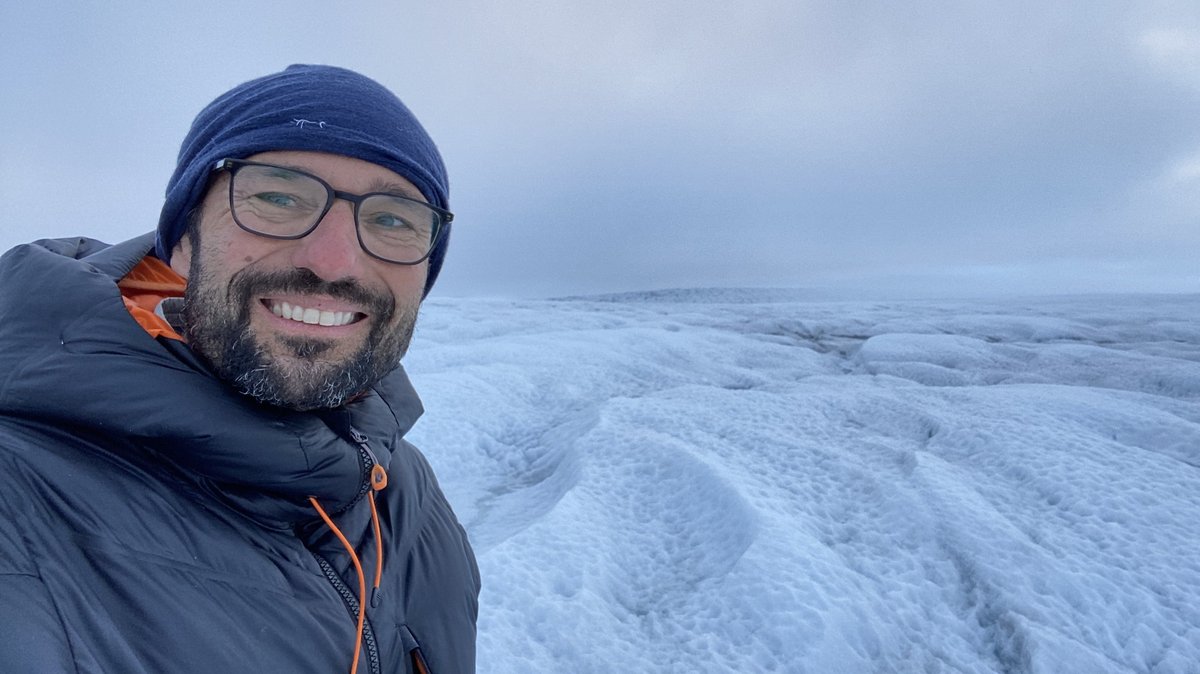
Dark algae in Greenland can feed themselves
New research shows that microscopic algae on the Greenland ice sheet sustain themselves on meltwater in a self-reinforcing process that contributes to global warming.

In the popular TV series The Last of Us, a parasitic fungus breaks through the asphalt and takes over the world. Nature strikes back - quietly, efficiently, and beyond human control. In reality, the threat is far less dramatic. It is invisible to the naked eye and does not grow in the ruins of cities, but on Greenland’s ice. Here, microalgae are spreading across the surface of the ice - darkening it in the process.
It may sound harmless, but the darker the ice becomes, the faster it melts. And although Alexandre Magno Barbosa Anesio has studied the phenomenon for years, his latest discovery has caused him concern. It turns out that the algae derive their nutrients from the very melting of the ice itself, in a mechanism that allows nature to reinforce its own development - rather like something from a dystopian television series.
“The small amounts of nitrogen and phosphorus released from the ice are sufficient to provide the microalgae with what they need to grow,” explains the professor via a Teams connection between Nuuk and Aarhus University. He has no doubt about what this will mean for global warming:
“These microorganisms produce pigments that absorb sunlight and make the ice sheet less reflective. The darker ice melts more quickly, which will cause global temperatures to rise.”

Remote sensing and close-up sampling
Alexandre Magno Barbosa Anesio is a professor at the Department of Environmental Science at Aarhus University. He was recently appointed to lead ARC, an Arctic network where stakeholders from across sectors can collaborate on research projects and share knowledge and technology. Such collaboration will be essential given the rapid spread of microalgae across the ice sheet.
“The microalgae are not the problem in themselves. They are simply responding to changes that humans have already set in motion, and we need to understand the process,” he says, emphasising that so-called remote sensing will be key to these efforts.
Measurements taken using satellites, drones, and aircraft enable researchers to monitor vast areas of the Greenland ice sheet and track developments over time. These data must then be combined with Alexandre Magno Barbosa Anesio’s local samples of the dark microalgae, which offer greater precision. Together, they provide a stronger foundation for improved climate predictions.
Imprecise climate models
For Carsten Suhr Jacobsen, climate models represent the greatest uncertainty in the Arctic. As head of the Department of Environmental Science at Aarhus University, he believes they do not sufficiently account for the darkening of the ice caused by the dynamic growth of algae. As a result, climate models risk underestimating how quickly the ice sheet is melting.
“Just a few years ago, this darkening was considered a fixed parameter, but with these ice algae effectively feeding themselves, there is now considerable uncertainty about how much global temperatures will rise,” he says.
Aarhus University continues to play a central and leading role in research into the spread of microalgae. These days, the Arctic Science Summit Week is being held on the university’s campus, with hundreds of researchers from around the world in attendance.
According to Alexandre Magno Barbosa Anesio, a permanent presence in Greenland is essential to understanding the microscopic process which, although invisible, may prove to be a major eye-opener.
“We can see that they awaken very early after the winter and quickly begin to grow, doubling the amount of algae. Everything we have learned about microalgae over the past five to six years concerns me,” he says.