New Research Questions the Value of Planted Forests
If the goal is to strengthen biodiversity, it is not enough simply to establish vast areas of uniform forest plantation, which may become one of the outcomes of Denmark’s Green Tripartite Agreement. The survival of species in Denmark requires that nature be allowed to take care of itself to a much greater extent. This is the conclusion of new research from Aarhus University, which has examined the major differences between planted forests and forests that have regenerated naturally.

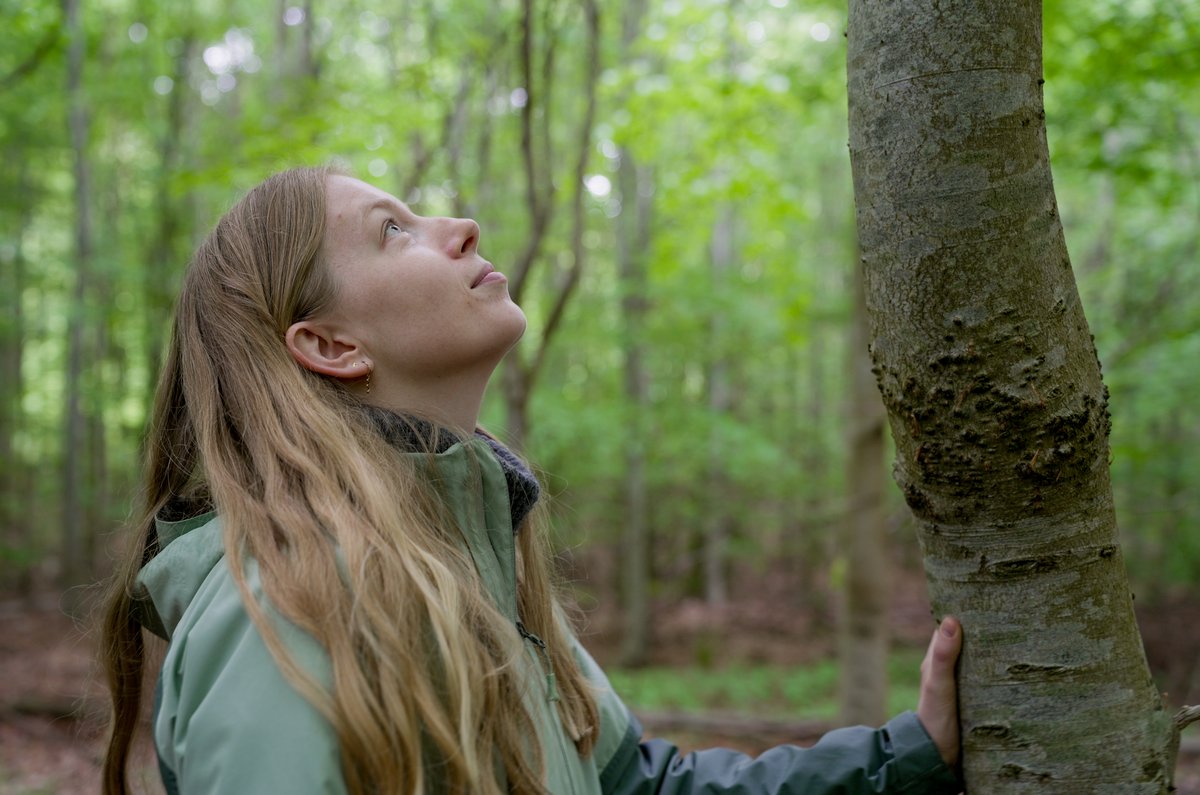
Over the past year, Emilie Thunbo Kallesø from the Department of Biology has spent most of her time in the forests around Aarhus, where she has analysed the diversity of trees, shrubs, and herbs on an unprecedented scale. Geding, True, Solbjerg, and Lisbjerg Forests are among the areas that have been heavily traversed, and together with academic supervisors from the Department of Ecoscience, the young student has produced a series of highly relevant research findings for society: forest diversity increases when it is allowed to develop on nature’s own terms.
“It is remarkable what can happen in just 30 years if we allow forests to regenerate naturally and simply leave them in peace,” says Emilie Thunbo Kallesø, pointing to wood anemones and herb bennet as examples of species that emerge and enhance the biodiversity everyone talks about, but which few of us fully understand.
“Planted forests with tall, densely packed trees arranged in long rows may help reduce our CO₂ emissions and improve drinking water quality, but they do not contribute significantly to biodiversity in Denmark. My results show that forest species and ecosystems thrive much better under natural regeneration over many years,” she explains.
Age Is Just a Number
The contrast is particularly visible in Lisbjerg Forest, where planted beech trees stand in dense, perfectly straight rows directly beside wild shrubs and naturally regenerated vegetation. Only a narrow strip separates the two worlds. One is dark and predominantly brown; the other is light and green.
“In the naturally regenerated forest, 23 forest species and 5 ancient woodland species were identified, whereas the planted forest contained only 10 forest species and 2 ancient woodland species. So even though the two forests are almost identical in both age and location, the methods used to establish them have an enormous impact on biodiversity,” says Emilie Thunbo Kallesø.
As part of her thesis project, she has examined forest areas ranging from 5 to 200 years old, and it is especially in the younger forests that species’ living conditions depend heavily on their surroundings. The naturally regenerated forests contain an average of 14.6 species, while the planted forests contain only 8.2 species on average. According to her, the problem is that in our enthusiasm for multifunctional forests that are expected to do everything, we often fail to allow them to establish themselves under conditions where plants and animals can truly flourish.
Forest Law or Law of Nature
Under Denmark’s Green Tripartite Agreement, the aim is to plant 250,000 hectares of new forest by 2045. Of these, 100,000 hectares are to be established as untouched forest. However, according to Emilie Thunbo Kallesø, it is crucial to consider how these forests are created. If biodiversity is to be strengthened, natural regeneration should form an important part of future afforestation efforts.
The political parties behind the agreement have committed themselves to revising the Danish Forest Act, which today is primarily designed to maintain timber production. According to Emilie Thunbo Kallesø, this is the first essential step:
“The Forest Act struggles to accommodate the fact that forests in reality serve purposes beyond timber production, and revision is necessary if it is also to ensure that forests benefit biodiversity,” she says.
At Naturmødet in Hirtshals on 29 May, Emilie Thunbo Kallesø will present the findings of her research project. A few days later, she will defend her master’s thesis as a biology student at Aarhus University.
Here you can view the full programme for Naturmødet 2026: https://naturmoedet.dk/om-naturmoedet/program-for-naturmoedet-2026