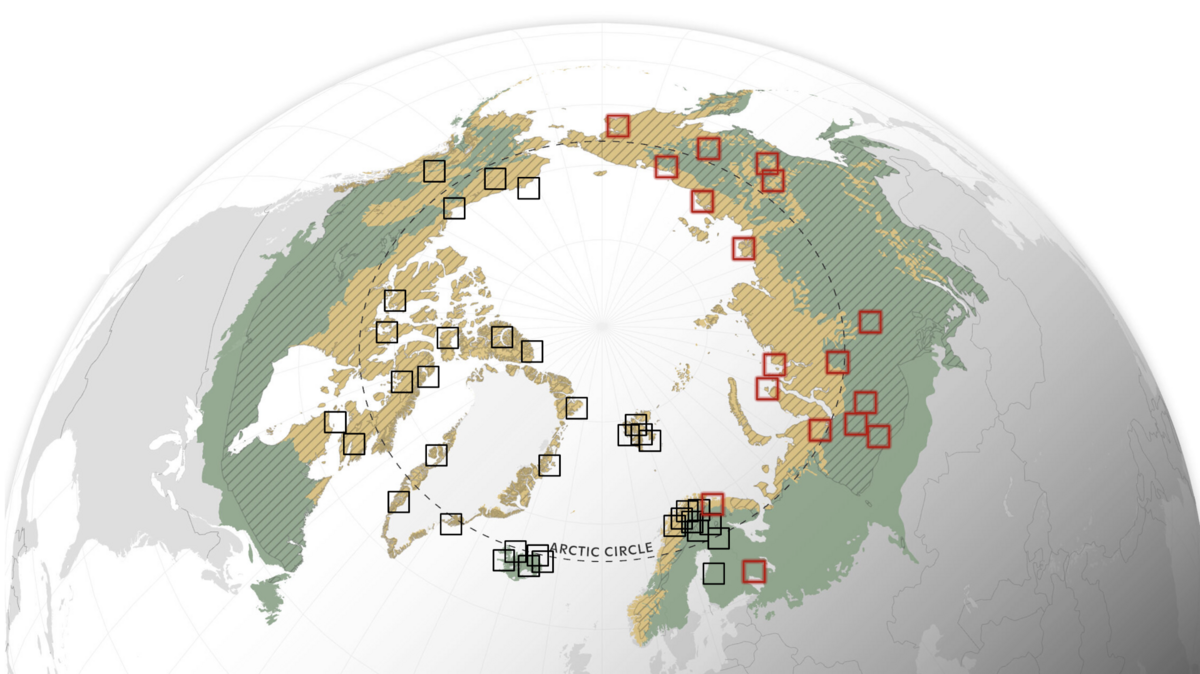
The war in Ukraine hits climate science: Half of the Arctic has disappeared from Western research
The lack of collaboration between Western and Russian researchers in the Arctic is creating significant uncertainty about climate change. At Aarhus University, scientists are now working on developing new methods to mitigate the problem.

The war in Ukraine has consequences beyond security policy and the economy. It also affects our ability to understand the climate changes that Spaniard Efrén López-Blanco has spent the past ten years mapping. He is a researcher at the Department of Ecoscience at Aarhus University, and from the Zackenberg research station in northeastern Greenland, he has a particular focus on measuring the carbon balance - that is, the accounting of how much carbon is absorbed by plants, soil, and the ocean, and how much is released back into the atmosphere. But in 2026, this has developed into an account that would not pass an audit:
"Russia and Siberia make up around half of the total land area in the Arctic, and because we no longer have access to their research stations, we are missing crucial knowledge about, for example, carbon storage and permafrost decomposition. Areas we have otherwise spent decades monitoring," he says, explaining that the lack of Russian data makes climate models less accurate. This means that researchers may underestimate how quickly the climate is changing - and that the actual developments correspond to what we would otherwise expect only by 2100, according to his own calculations.
Filling the knowledge gaps
For this reason, Efrén López-Blanco and his colleagues at Aarhus University have begun conducting advanced gap analyses of other regions where the climate, vegetation, and soil conditions resemble those of the Arctic. By combining field measurements, satellite data and climate models, researchers can identify precisely where the bias and data gaps are most critical. This approach can help fill some of the knowledge gaps that have only deepened since Russia invaded Ukraine and fell out with the West.
"It’s not ideal to be missing half of the Arctic data, but these new analyses are far better than nothing," he says.
Russian roulette with the climate
According to Terry V. Callaghan, drastic measures are needed. The British professor is one of the world’s leading experts in Arctic environmental and climate research, and he is the keynote speaker at the Arctic Science Summit Week, currently taking place at Aarhus University. It is a global forum for coordination, collaboration, and knowledge exchange, where Russian researchers have traditionally been well represented. This year, only two have registered - and they may not even be allowed to enter the country.
"It’s striking that even during the Cuban Missile Crisis in the 1960s we could meet with Russian scientists, yet now we cannot. Science, not politics, should guide our work," he points out, urging his colleagues around the world to find ways around geopolitical restrictions:
"Defy the authorities, don’t put science on hold. Work in parallel, share data indirectly, keep monitoring going. What happens in the Arctic does not stay in the Arctic, and we cannot understand climate change without Russia. We are talking about global climate impacts, from permafrost and methane emissions to changes in ocean currents. It affects us all."
The Arctic is extremely vast and features diverse ecosystems, and even with an international network of more than 90 research stations spread across the Northern Hemisphere, there are significant gaps in the data. The lack of access to the 21 Russian stations has only worsened the problem, which is why Efrén López-Blanco hopes that the new gap analyses can sustain climate research until collaboration with Russia can hopefully resume.
"Nature knows no borders. If we want to understand what is happening in the Arctic, we need to think across countries and find new ways of working, even when the world around us makes it difficult," he says.