
Knowledge and local dialogue drive Denmark’s green agricultural transition
Denmark is breaking new ground in the green transformation of agriculture. Through local tripartite partnerships, research-based advisory services, and emerging technologies, the country is tackling some of Europe’s greatest land-use challenges. Now the rest of the EU is watching—because the question is not only whether the green tripartite works in Denmark, but whether it can inspire change across Europe.


Across Denmark, land is becoming the focus of something rare: genuine cooperation. Local tripartite groups—made up of municipalities, landowners, environmental organisations and the Danish Nature Agency—meet to develop concrete plans for converting lowland soils, wetlands and farmland. This is not just talk. It leads to real action.
“Agriculture has become more professional—and you notice that as a biologist,” says Flemming Kofoed, Chair of the Holstebro branch of the Danish Society for Nature Conservation and member of the local tripartite group near Nissum Fjord. “There’s more attention to what life is like on the farm, and knowledge is being brought into play. I sense a new willingness to find solutions.”
Just a few decades ago, these actors might have been entrenched in opposition. Today, they sit down together to negotiate—with support from advisors, researchers and new technologies. Kofoed is one of many involved in the local tripartite groups, where a major generational shift, new funding mechanisms and technical progress have created new conditions for cooperation. And it’s working:
“We’re making real headway in river valleys and low-lying areas, without conflict with farmers. The tone has changed.”
The Danish approach to land use and agriculture is attracting growing international attention. The question now is whether the green tripartite can be exported. What does it take to create local cooperation? Can this model work in countries with very different traditions of land management?
A Danish model with European attention
According to Jørgen E. Olesen, Professor at Aarhus University, the results arise from a combination of factors:
“We need more technology. It’s technology that solves things. We have an advisory system that works directly with farmers. We have research-based knowledge, political will and funding. There are many countries where these conditions aren’t in place. The green tripartite is not something you can simply export—but you can learn what’s required.”
He adds that technology must be accompanied by business models that make sense for farmers:
“Many of the solutions we want are only possible because the technology exists. But there’s not always willingness to pay—so it also has to make financial sense.”
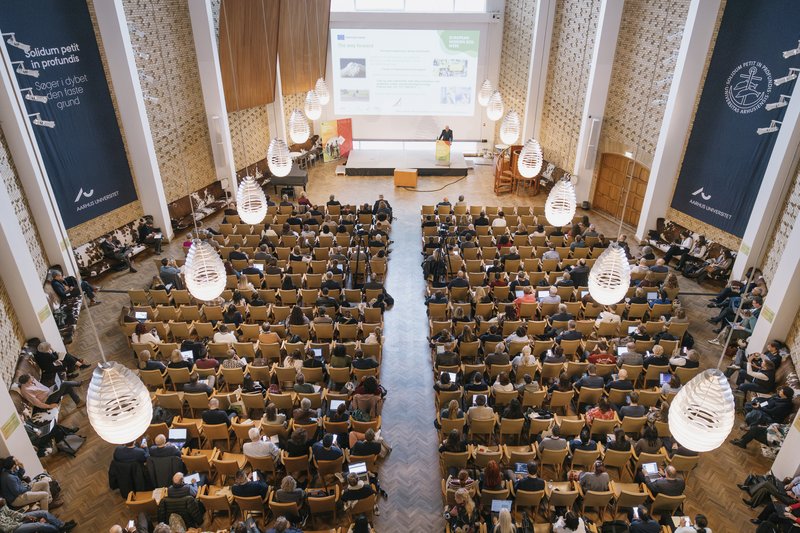
The Danish model for green agricultural transformation is gaining increasing international interest. During European Mission Soil Week 2025, held on 5–6 November at Aarhus University, the tripartite model is one of the most discussed topics.
According to Diego Canga Fano, Acting Deputy Director-General at the European Commission’s Directorate-General for Agriculture and Rural Development:
“Denmark deserves particular recognition for its leadership in sustainable agriculture. You’re showing that productivity and environmental care can go hand in hand. Danish farmers have long understood that healthy soil is the foundation—not just for production, but also for resilience and sustainability.”
Eskild Holm Nielsen, Dean of the Faculty of Technical Sciences and host of the conference, emphasises the broader perspective and the importance of research and shared goals:
“Soil is more than something we stand on. It supports plants, animals and people. It feeds us, stores carbon, purifies water and stabilises the climate. It reminds us that the mission is not only a scientific effort, but also a shared European goal—one that depends on cooperation between researchers, policymakers, and citizens.”
Grass, cooperation and business models
Technological development is also enabling new crops and business models. Klaus Kristensen, a cattle farmer, sees great potential in grass and biomass:
“Grass is one of the most effective crops for improving soil health. And with new technology, we can extract protein and use it for feed. That would be like gold from the sky.”
Christian Høegh-Andersen, Deputy Chair of the Danish Agriculture & Food Council, agrees:
“Grass has a big future in Danish agriculture. It has many uses, and I think we’ll see even broader applications—in biogas, biorefining and textiles.”
These technologies pave the way for a green transition—but they require investment and the right framework conditions.
“Most farmers would rather deliver on nature than pay a tax,” says Kristensen.
A shared European goal for healthy soils
Denmark’s green tripartite model is increasingly being followed in Brussels and other European capitals—especially in light of Mission Soil, one of the EU’s five flagship missions under Horizon Europe. The aim is for at least 75% of Europe’s soils to be healthy by 2030. To reach that goal, local partnerships, public engagement and knowledge-based action are essential.
Here, the green tripartite stands out—not as a technocratic solution, but as a collaborative model where municipalities, landowners, NGOs and public authorities all have a seat at the table.
“The main lesson others can learn from us is bringing all parties to the table,” says Maria Schack Vindum, Permanent Secretary in the Ministry for the Green Tripartite. “Not necessarily regulating everything from the top—but setting visions and goals, giving local ownership, and mediating between stakeholders.”
She continues:
“It’s a national plan, but it’s the local partnerships—in close cooperation with landowners, citizens and organisations—that bring it to life. Bringing farmers and nature organisations to the same table has proven to be a powerful tool.”
Vindum hopes the Danish experience can inspire other countries to create new forms of dialogue and build bridges between interests:
“When we work together, we can achieve both green goals—and maintain a strong agricultural sector.”
Flemming Kofoed shares that ambition:
“We’ve cultivated Denmark far more intensively than the European average, so we have a particular obligation to give something back. There’s growing awareness in agriculture of its societal role. The tripartite work is the beginning of something big. We’re underway, and the finer details will come later. We’re paving the road as we drive. And there’s reason to be optimistic—even for a biologist like me.”
FACT BOX
> What is the Green Tripartite?
The Green Tripartite is a Danish cooperation model between the government, labour market stakeholders, civil society, and knowledge institutions aimed at supporting the green transition in agriculture.
National Tripartite: Includes the Danish government, the Danish Agriculture & Food Council, the Danish Society for Nature Conservation (DN), the food workers’ union NNF, Danish Metal, the Confederation of Danish Industry, Local Government Denmark (KL), and the climate think tank Concito.
Local Tripartite Groups: 23 local partnerships anchored in municipalities, consisting of representatives from local governments, farmers' organisations, environmental NGOs and the Danish Nature Agency. They develop local land-use plans and help implement national political agreements.
> Biomass, land use and moving beyond fossil fuels
Europe faces a major challenge: to develop bio-based alternatives to fossil fuels and materials—without compromising food production or nature.
Biomass from grass, lowland soils and wetlands could play a key role. By converting wetland areas to grasslands and harvesting them for feed, biogas or green chemicals, it’s possible to store CO₂, enhance biodiversity and create new green products. But this requires technological innovation, land-use planning and local agreements.